
Did That First Container Actually Make Any Money?
A student posted in the group last week.
She’s about to order her second container. Before she hit go, she wanted to work out what the first one actually made.
Fair question. Probably the most honest one you can ask after your first run.
She’d already started a list…
Total revenue
Supplier cost and freight.
Insurance. 3PL
The photo shoot.
And then “Ad cost??” with two question marks on it.
Some people clicked her ads and bought something else. Some came in the other way.
So… did it make money?
My answer… “it depends”. Ha.
I know how that sounds.
To work out if your own brand beats dropshipping, you have to pick a point in time to look at the numbers.
Go all the way to the very end… holding costs, company tax, personal tax… and there are way too many variables.
Holding cost is constantly moving.
Your personal tax depends on what you’ve made elsewhere and how your structure’s set up.
You end up comparing a pile of things that have nothing to do with the product.
Think about how you look at a dropship product.
Your supplier sends a price sheet. You can see a 20% margin.
That’s an 80% product cost ratio (PCR)… the share of every sale that goes to product cost.
You don’t load every running cost in the business into that number. You look at it at that one point.
So I look at my own brand the exact same way.
Our Order Calculator lays out what our own product costs us, like a price sheet from a dropship supplier.
Apples to apples.
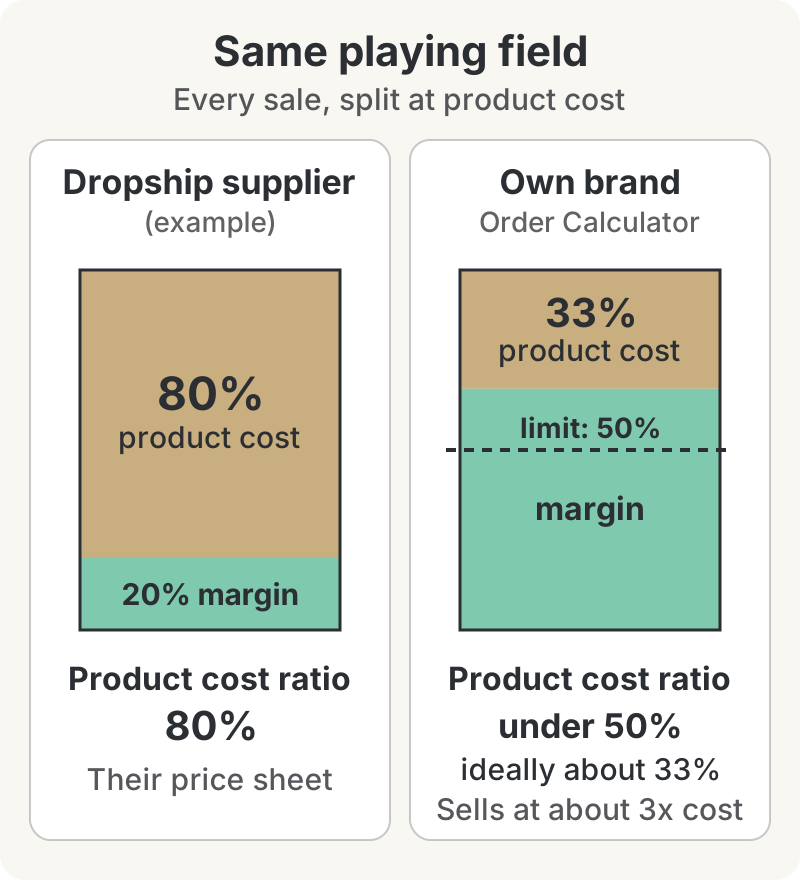
On my own products we aim for under 50%, ideally around 33%.
We sell them for about 3x what we buy them for.
And yes, there are extra costs after that point.
The photo shoot.
Heavier ad spend at the start, because nobody knows your brand yet and a new campaign needs time to learn.
Maybe paying influencers for content too.
All of that comes out of profit.
But some of it only happens once.
You won’t need a new photo shoot every time a container lands.
Put it in the P&L as a once a year, or once every two years, cost and spread it across that time.
One container doesn’t have to carry it on its own.
So when you ask “did this first container make me any money”, look at it from a few angles.
If I was just dropshipping, what would my profit be?
With my own brand, what is it now?
Which of these first-container costs will show up again on the second one?
Then step back. Thirty thousand feet.
Look at the whole business.
In the beginning you’ll sell less of your own product than dropship. That’s normal.
Over time the goal is to grow your brand share… of all your sales, how many were your brand and how many were dropship.
The more of your own high margin product you sell, the lower your PCR goes across the whole store.
When product cost takes a smaller bite, that money has to land somewhere.
After all the other expenses come out, the only place left for it to go is profit.
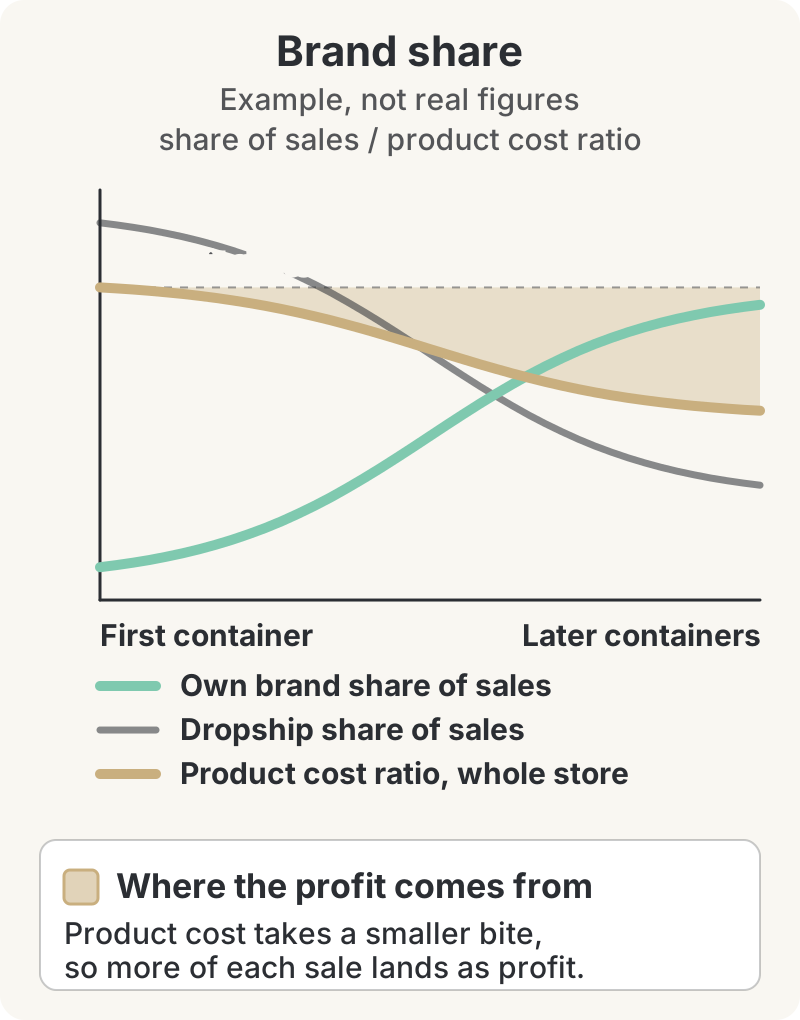
She mentioned her overall PCR has dropped since she started selling her own products.
That’s the one I’d be watching.
One colour also sold way better than the other, so she’s shifting the split on the second order.
She had an educated guess the first time. Now she’s got real data to order from.
If you’re sitting on your first container right now keep it simple.
Check the product margin like for like against what your dropship suppliers give you.
Then look at the whole business and ask two things.
Is my profit better because of my own brand sales?
And if I sold more of them, would I be more profitable?
The answer’s almost always yes. So that’s what we aim at.
- Matthew