
How to Price Products When You Own the Brand
In 2018 we started selling our own imported brand of products.
Our manufacturer in China sent through a price list. I remember sitting there looking at it wondering how I’d come up with the right sale price… what we sell it for.
There’s no column for that.
When you’re dropshipping, your supplier hands you the price.
“Here’s the RRP, here’s your discount, off you go and make sales for me”
You never have to think about it, and I’d been doing it long enough that I’d stopped noticing it was happening at all.
Own brand, you invent the number yourself. And nobody tells you when you’ve got it wrong.
You just end up making less profit than you should have, for years, and never find out.
So when I was doing this for the first time, I did what I reckon most people do…
I tried to work it out from the cost.
Cost plus a markup
It felt right at the time.
My product lands here at $200, put 150% on it, sell it for $500. Do that across the whole range and you’ve got the same margin on everything, which felt responsible. Tidy.
Then I ran it across our rubber doorway ramps and I found the problem.
We sell those in a stack of sizes, from a 20mm lip for a doorway all the way up to ~150mm.
And on the manufacturer’s price list, the first few sizes were all the same price.
Same cost for a 20mm, a 30mm and a 40mm.
I’ve never had it confirmed, but the reason is obvious enough.
It’s the same amount of labour for them either way.
A bit more rubber in the bigger one, not enough to bother repricing over… So they’ve rounded it up or down to make things simple for themselves.
Which meant cost-plus was handing me three different products at one price.
Why that doesn’t work…
Three things are going on, and they all point the same way.
The first is that your customer prices value off a reference they have in their head, not off your cost sheet.
Everyone lands on your page already carrying a rough sense of what a thing like this should cost, built out of the category, the competitors, and a gut feel about materials.
Your landed cost isn’t anywhere in that calculation. So the 40mm gets judged against what a 40mm variant of a doorway ramp should cost
And the 20mm against what a 20mm doorway ramp should.
Charge the same for both and one of them is wrong by definition.
The second is that price is the spec level (quality) when there isn’t another one.
A stranger can’t assess your rubber. They’ve never held it, and even if they did they’d likely not understand the subtle differences in quality.
So they read the price as the quality.
Overly cheap doesn’t say bargain to them, it says “what’s wrong with it?”
And the third is that a range that doesn’t step stops working as a range. If the 20, 30 and 40 are all the same money, you haven’t got small, medium and large. You’ve got one product in three flavours. You lose the thing where the little one makes the big one look sensible, and you lose the up-sell with it.
You have to separate price from cost
Cost is a fact you’re handed. Price is a decision you make.
And you make it off the market, not off the cost.
Trouble is, “the market” is a pile of things you can’t see.
How people feel about your brand.
How you look sitting next to the other options.
What they already believe before they’ve landed on the page.
None of that fits in a spreadsheet.
So what you’re really doing is forming a hypothesis and testing it.
“If I price it here, how many do I sell, and what does that leave me?”
“What happens if I move it there?”
Because there’s one point where those two things meet.
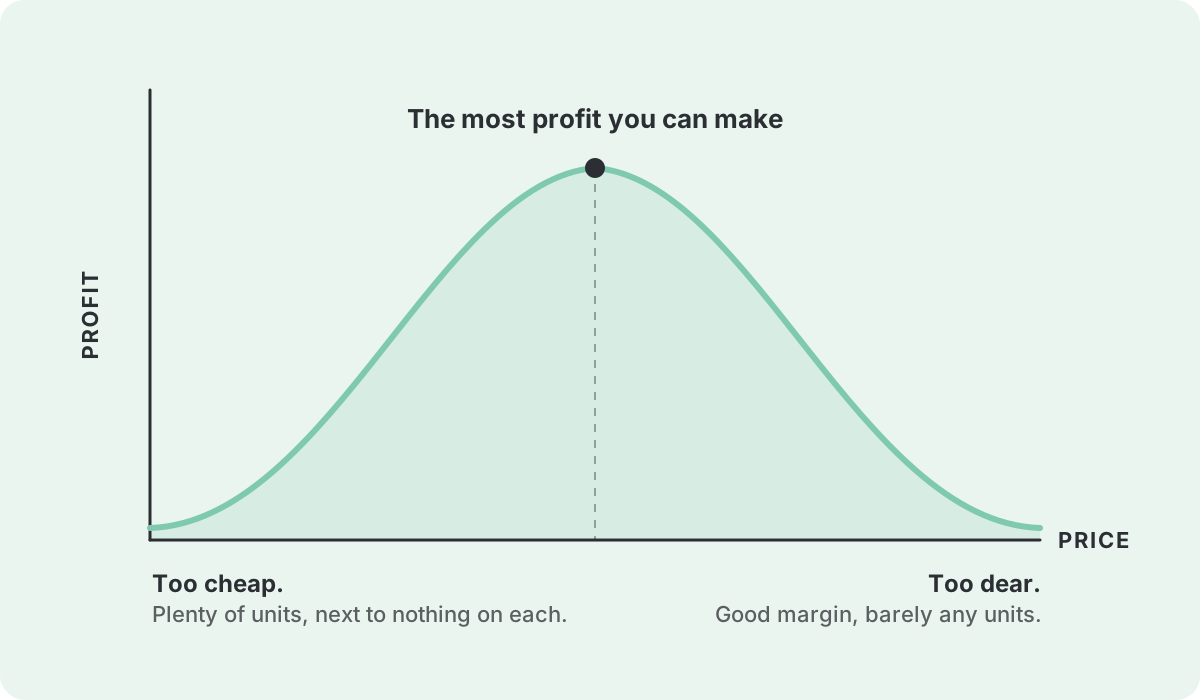
Cheap end, you’ll shift plenty of units and make next to nothing on each one.
Dear end, lovely margin, nobody’s buying.
Somewhere in the middle is the price that makes you the most profit, and that spot is the only thing you should be aiming at.
Your margins will be all over the place, and that’s fine
This is the part that took me a while to get comfortable with.
(OCD much?)
Once you stop pricing off cost, your margins stop being consistent.
Some products will make you great money. Some will make you very little.
Our small doorway ramp earns us almost nothing and the big one earns us a lot.
But if I went hunting for a clean 40% product cost ratio on every SKU I’d have to put the small ones up until nobody bought them.
You’ve only got one dial anyway…
You don’t set your cost, your manufacturer does that.
You don’t set your velocity either, the market tells you that once you’ve picked a number.
Price is the only thing in your control, and profit is just what falls out the other end.
So you’re not optimising each product. You’re optimising the brand.
Which means you’ve got to be able to see the whole thing.
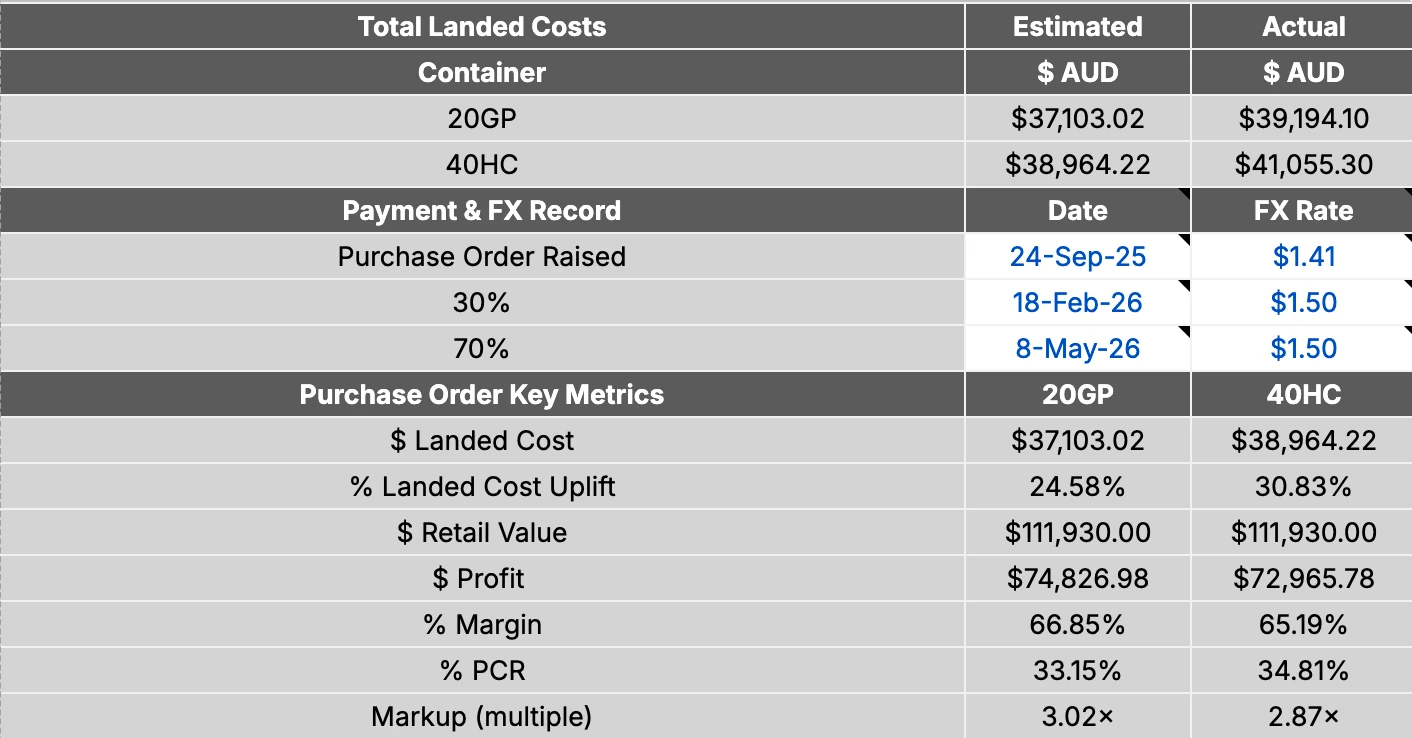
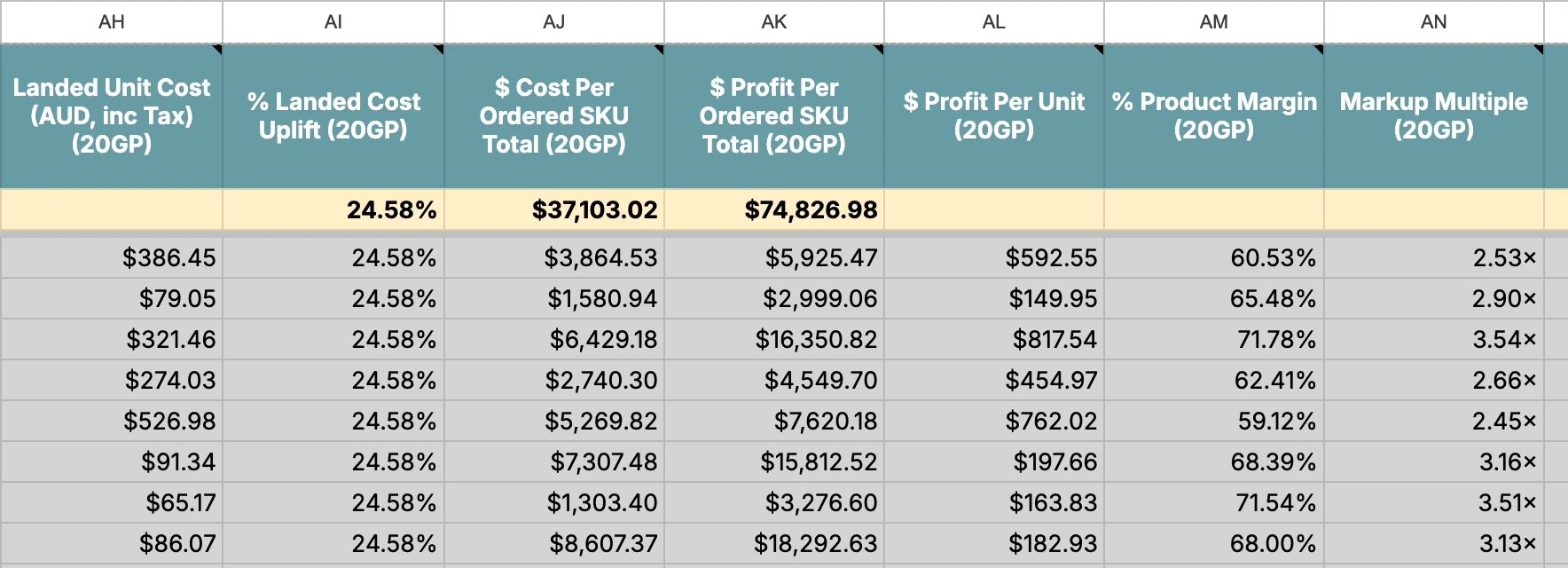
We run an Order Calculator that shows margin at a product level and across the entire purchase, per container or per LCL order, so we know the overall margins, PCR and markup multiple.
And then the same numbers again, broken down line by line, so you can see which products are carrying the order and which ones are along for the ride.
So how do you find the sweet spot?
Honestly? I make it up.
That’s the real answer and I’d rather say it than pretend there’s a formula we use.
What I’d tell myself if I could go back though is this:
Look at the data first.
If you’ve only done a handful of sales, you haven’t got enough to decide anything with, and you’ll end up reading noise as a signal.
You need enough of it in front of you before it starts telling you the truth.
”But I haven’t sold any of it yet”
Yes you have.
That’s the bit people miss.
You’ve been selling into this exact market on thin dropship margins for years.
You know what moves and what doesn’t.
You know why.
And you’ve got customers telling you constantly what they would have bought if it had been a bit cheaper, or a bit better, or came with the thing that never comes with it.
Use all of that!
This is the bit we spend the most time on. There are eight ways to take a product you’re already selling and build a better version of it, and we run every product through all eight before anyone orders anything. We call it the Product Gold Filter.
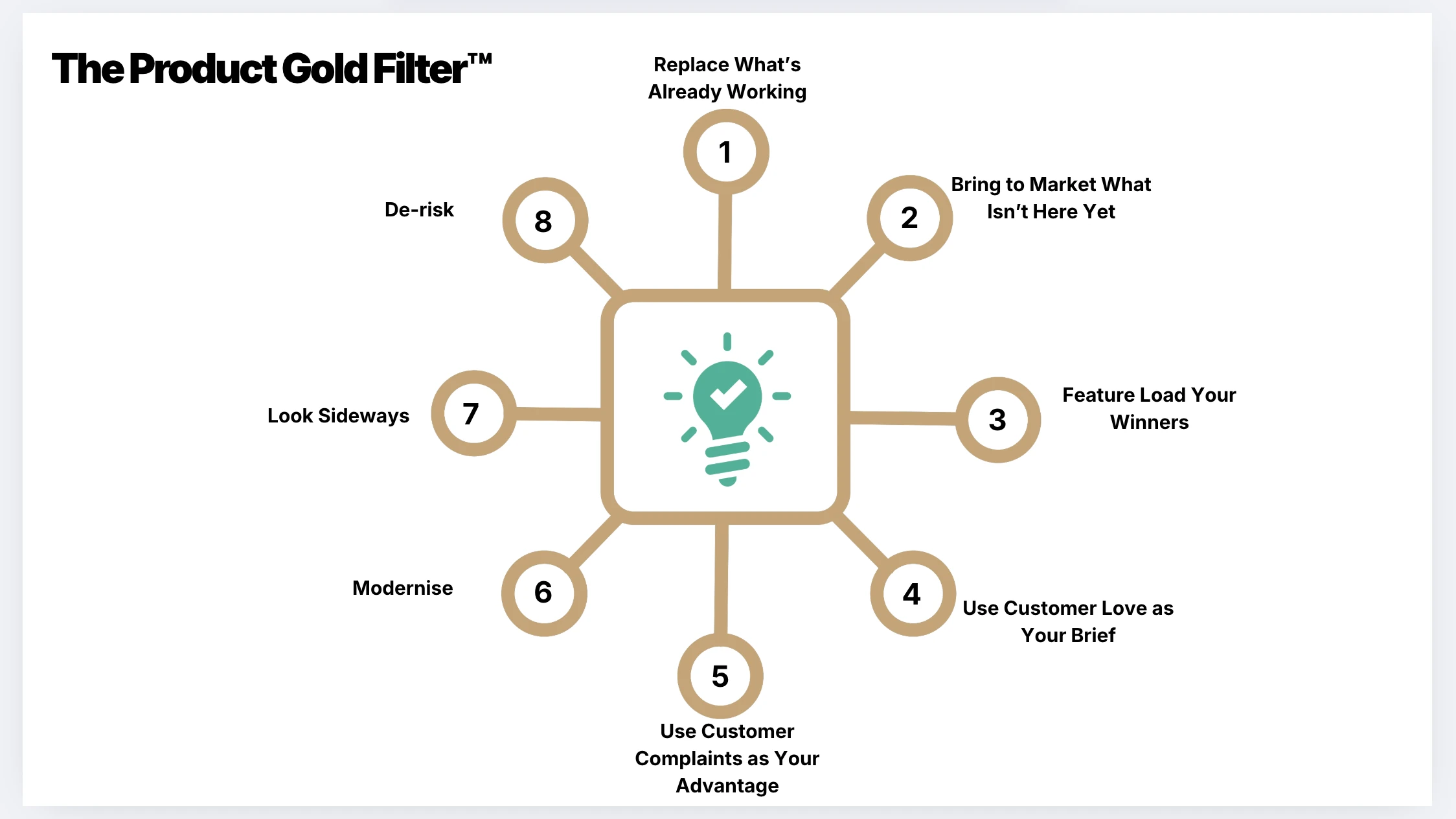
You don’t need all eight today. The point is that value stacking isn’t a feeling, it’s a checklist. Run your best seller through it and you’ll come out with three or four things the current version doesn’t do.
Value stack it until choosing anybody else looks mad, then price it where your best sellers already sit.
It’s a better product than the one you were shipping. It should sell better.
If you want more certainty than that, go slightly under. You’ve got no reviews yet and no brand equity, so there’s a fair case for buying your way past both.
But do not go too low
Too cheap has the opposite effect to the one you’re hoping for.
You’ve felt this yourself on Temu or Amazon I bet…
Something looks incredible, it’s $14.50, and you close the tab.
Not because you can’t afford it. Because there’s no way it actually works.
Don’t do that to your own product.
And then you move it
Pricing isn’t something you do once and file away.
We put prices up on triggers…
When a cost moves beyond the normal fluctuation, and on a clock as inflation does its thing.
A few years back the price of aluminium jumped and we put a 10% raw materials loading charge across the affected range.
Passed it straight through. Sales didn’t move at all.
I know a lot of people right now are staring at a supplier increase and treating it like a catastrophe.
Sometimes it is.
Most of the time it’s just a number you were too nervous to test.
The lever you actually want
On day one, price is the only lever you’ve got. That’s the only trick in your magic hat.
But every month you’re also building brand equity, and that’s the one that moves the curve itself.
The more people who resonate with your brand, the more of them will pick you over the option that’s statistically better on paper.
Which lets you charge more…
Which drags that peak further to the right. More profit.
Price is what you set today.
Brand equity is what lets you set a better one next year.
PS. If this landed, we’ve just opened up a few spots in Escape Velocity.
It’s where we work through every step of the move from dropshipping to owning your own brand, the same way we’ve just done with pricing. The Order Calculator and the Product Gold Filter both live in there.